


Current Affairs & Islaamic History

In the Name of Allâh, the Most Beneficent, the Most Merciful
|
The life of the Muslim Ummah is solely dependent on the ink of its scholars and the blood of its martyrs. What is more beautiful than the writing of the Ummah's history with both the ink of a scholar and his blood, such that the map of Islamic history becomes coloured with two lines: one of them black, and that is what the scholar wrote with the ink of his pen; and the other one red, and that is what the martyr wrote with his blood.
Shaykh Abdullah Azzam |
History of Islam (3 Volumes)
History stands as the most effective and valuable source of putting nation on the course of progress and prosperity and saving them from the path of disgrace and degradation. At a time, when there is tough competition among the nations of the world to excel one another, the Muslim, despite having the most glorious history, appear to be detached and careless as regards their history. This book presents the true Islamic events and their actual causes before the English readers because the other books in the English language found on the Islamic history have been written by such authors and compilers who did no justice in presenting the true picture of Islamic Era but their prejudice prevented them from doing so. |

Conquest of Constantinople
Islamic Legacy is a project that aims to take Muslims on a journey through time, studying the history of Muslims, including the People of the book (Jews and Christians), from an Islamic as well as a contemporary point of view. Islamic Legacy relies primarily on the most authoritative texts on Islamic history. These include the works of At Tabari, Ibn Kathir, and Ibn Athir to name a few. However, Islamic Legacy also draws on texts by certain non-Muslim scholars that have devoted their lives to researching various aspects of Muslim history. All material is overseen by Sheikhs based locally and overseas. |
The Lost Kingdom of Al-Andalus
The much awaited audio narration of glorious history of Islam in modern day Spain and Portugal is due to be released in October insha'Allah. Like all our previous productions, this epic tale has been professionally scripted and narrated. "In the forgotten realms of Europe, during its darkest hour, a light arose. As time went on, this light shone brighter than ever, attracting, mesmerizing and inspiring all those who encountered it. However it was taken for granted until it began to fade, until after 8 centuries it was no more. This luminosity was Al-Andalus, a land of the Muslims which sparkled and shimmered is a way the Europe had never perceived before and perhaps will never experience ever again. |

The Crusades Through Muslim Eyes
In the 11th century, almost a thousand years ago, hordes of Christians warriors bearing a red cross stormed into Syria. They journeyed from all parts of Europe, pillaging and slaughtering innocent Muslims along their way. They captured Jerusalem in 1099 leaving no mosque to pray in, nor any Muslim alive. After a hundred years, with the help of Allah, the Muslims struck back... |

Raid of The Mongols
In the seventh century of Islamic history an event occurred that changed the world. Had this episode of history not been documented they say it would not have been believed! The Mongol army headed west into the Muslim lands and Baghdad and attacked the capital of the Abbasid Caliphate. |

1001 Inventions : The Enduring Legacy of Muslim Civilization
Author: Salim T. S. al-Hassani | Pages: 356 | Size: 120 MB 1001 Inventions: The Enduring Legacy of Muslim Civilization takes readers on a journey through years of forgotten Islamic history to discover one thousand fascinating scientific and technological inventions still being used throughout the world today. Take a look at all of the discoveries that led to the great technological advances of our time; engineering, early medicinal practices, and the origins of cartography are just a few of the areas explored in this book. 1001 Inventions provides unique insight into a significant time period in Muslim history that has been looked over by much of the world. A time where discoveries were made and inventions were created that have impacted how Western civilization and the rest of the world lives today. The book will cover seven aspects of life relatable to everyone, including home, school, hospital, market, town, world and universe. |

|
Stories of the Prophets (IIPH Version)
This book deals with the important events of God's prophets and Messengers from Adam, the first prophet, to Jesus (peace be upon them all), compiling the stories from the Qur'an and the narrations of the Prophet Muhammad (peace be upon him) that have been authentically reported. Believing in all the Messengers and prophets of Allah is one of the pillars of faith in Islam. Denying any of them is a form of disbelief which if not repented leads to the hell-fire. Similarly, exaggerating about any of them beyond the honourable status that Allah, the Almighty, has given them, as the followers of many faiths do, is also wrong. {The Messenger [Muhammad] believes in what has been revealed to him from his Lord, as do the believers. Each one [of them] believes in Allah, His Angels, His books, and His Messengers. We make no distinction between any of His Messengers. And they say: We hear and we obey. [We seek] Your forgiveness, our Lord, and to You is the [final] destination.} (Qur'an 12: 3) {So relate the stories that perhaps they will give thought.} (Qur'an 7: 176) The renowned commentator on the Qur'an, expert in Hadith, and historian, Ismeel ibn Katheer has compiled the Stories of the Prophets from the Qur'an and the narrations of the Prophet (blessings and peace be upon him) that have been authentically reported. The book is unique in its content, dealing with the important events of the prophets and Messengers with all authenticity right from Adam, the first prophet, to Jesus, peace be upon them all. As for Prophet Muhammad, the author has written a separate book about his biography. Ibn Katheer's Stories of the Prophets has been translated here by Husain Maqbool. |

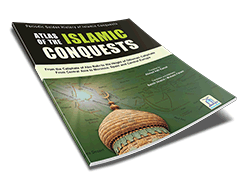
Atlas Of The Islamic Conquests
Author: Ahmad Adil Kamal | Pages: 490 | Size: 384 MB "Atlas of the Islamic Conquests" has been prepared in view of the same lofty aim. In it are events of consecutive days, months & years of major Islamic Conquests, starting from the period of first Caliph Abu Bakr Siddiq (RA) to the reign of Ottoman Caliph Murad 3, have been described, with full color maps and unique snaps, in such a manner that the reader goes along with them and comes across wonderful historical happenings and new secrets of History are disclosed. |
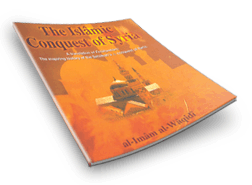
The Islamic Conquest of Syria
Author: al-Imam al-Waqidi | Pages: 587 | Size: 32 MB This is the first complete English translation of Futuhusham, the ninth century Arabic classic detailing the Muslims advance into Syria when a small band of faithful Muslims overthrew the superpower of their day. This inspiring epic describes the events in detail and brings to life the great personalities of Islam in a unique way. |
The Muslim Conquest of Persia
Author: A I Akram | Pages: 322 | Size: 10 MB Following the publication of 'Khalid ibn Waleed - Sword of Allah,' there has been a huge revival in reader's interest for books dealing with early Islamic History. It was decided that we complete the task of publishing the [out of print] books by A.I.Akram on the first hundred years of Islam. |
The Muqaddimah : An Introduction to History
Author: Ibn Khaldun | Pages: 681 | Size: 4 MB The Muqaddimah, often translated as “Introduction” or “Prolegomenon,” is the most important Islamic history of the premodern world. Written by the great fourteenth-century Arab scholar Ibn Khaldun (d. 1406), this monumental work established the foundations of several fields of knowledge, including the philosophy of history, sociology, ethnography, and economics. |
The Day of Wrath
Author: Safar al-Hawali | Pages: 123 | Size: 1 MB Author's Introduction, 'The contents of this booklet are glad tidings to the oppressed people of the occupied territories particularly, and to all Muslims in general. However, it was not written to give them glad tidings, the Qur’an and the Sunna are sufficient for that purpose. Any other source has limits to its reliability and therefore cannot be the basis of Muslim belief, in contrast to what is supposed by some Christians, Jews and Muslims. No, this booklet was written only to outline terms for engagement with the theoretical foundations of Zionism in its two facets: Jewish Zionism and Christian Zionism, the enemy which has distracted the world, and filled the airwaves as well as books with talk of Biblical Prophecy –especially since the latest intifadha. |
The Lofty Virtues of Ibn Taymiyyah
Author: 'Umar bin 'Ali al-Bazzar | Pages: 34 | Size: 1 MB By The Imam, the Hafidh Abu Hafs 'Umar bin 'Ali al-Bazzar. Translated By Abu Sabaayaa. “If I had to swear standing between the corner of the Ka'bah and the spot of Ibrahim, I would swear that I have not laid my two eyes on anyone like him, nor has he seen anyone as knowledgeable as himself.”
- al-Hafidh adh-Dhahabi |
Collection Of Biographies Of The Companions
The Sahaabah were the companions of Prophet Muhammad (saw). They are described in glowing terms by the Prophet (saw) as the following hadith from Sahih Muslim shows: Book 30, Number 6159 Narrated Aisha: A person asked Allah's Apostle (peace be upon him) as to who amongst the people were the best. He said: Of the generation to which I belong, then of the second generation (generation adjacent to my generation), then of the third generation (generation adjacent to the second generation). |
The History of the Khalifahs
Taken from Tarikh al-Khulafa, this classical work presents authentic hadith about the first four Khalifahs of Islam, may Allah be pleased with them, illustrating both the integrity and wisdom that they displayed in governance. This book also highlights their contributions to that body of practice which is known as the Sunnah. |
The letters of the Prophet Muhammad
Prophet Muhammad's letters to Emperor Heraclius, Chosroes II, Muqawqis, Negus, Governor of Syria and Ruler of Bahrain. |

Muslim Unity
Author: ibn Abdul Hameed | Pages: 116 | Size: 1 MB The unity of the Ummah, Is difference a matter pre-decreed and something, which has to happen? Ignorance and oppression (zulm) are the root of every evil, The beginning of party spirit (hizbiyyah) in Islamic work, Shall we remain silent until we become like the ostrich? Are the Jamaa?ahs a result of the revival or the opposite? Does partisanship accord with unity? Let us ward off the confusion of the Believing youth |
Why Allah (swt) Decrees Wars and Catastrophes
Author: Muhammed Salih Al-Munajjid | Pages: 9 | Size: 1 MB There is a wisdom behind everything that appears evil; wars, poverty, diseases, famine, earthquakes, volcanoes, and even the existence of disbelief upon the earth; when people kill each other, it happens for a reason. There is wisdom behind everything, even the creation of Satan, which only the people of knowledge can comprehend. This book is an adaption of a Friday Jummah Khutbah given by Shaykh Muhammed Salih Al-Munajjid dealing with the wisdom behind Allah's (swt) decree. |
Reflection Upon The Current Crusade War
Author: Muhammed Salih Al-Munajjid | Pages: 8 | Size: 1 MB Indeed, Allaah responds to the supplications of Muslims. More often than not, Muslims raise their hands in prayer, during trials and disasters which inflict some Muslim countries, like in the period we are living now. How many times did the Muslims invokeAllaah? How many old men and women beseech Allaah, with humbleness? This book is an adaption of a friday khutbah given by Sheikh Muhammed Salih Al-Munajjid that makes a clear distinction between our dua and Alllahs help in whatever shape or form Allah (swt) sees best. |
|
The Clash of Civilisations
Author: Bilal Philips | Pages: 152 | Size: 4 MB In a time when Muslims in the West live in an environment of turmoil and difficulty facing new challenges daily, they encounter a cultural dilemma, a clash of the Islamic and Western civilisations. Therefore, it is of the utmost importance to know the foundations of these cultures, the differences between them as well as understanding Islam correctly taken from its pure sources. In this book, the author highlights these aspects of the two cultures whilst also giving a detailed explanation of the core beliefs of Islam. |
History of Palestine
Author: Fawzy al-Ghadiry | Pages: 69 | Size: 1 MB This study of the History of Palestine stresses on the right of every human being to return back to his homeland, and to stress that the right of return and ownership of lands and homes is an eternal, individual and collective right that no occupation, state, treaty, agreement can gainsay, as every occupation no matter how long it lasts, and no matter how strong it is, is doomed to extinction. |
Salah ad-Din al-Ayyubi (Saladin)
Author: Abdullah Nasih Ulwan | Pages: 212 | Size: 12 MB Talking about the lives of our great figures in history, leader in jihad and men in the field of reformation in the best talk and the most beloved remembrance because they were the guiding lights for people. Salah ad-Din was one of those who guided people to the right path. One may ask why the author preferred Salah ad-Din's biography over other figures. The answer is that Salah ad-Din's life is connected with the manifest victory and liberation of Jerusalem from Crusaders. Readers will find in book chapters how such victory was achieved by a Kurdish man, not an Arab; how he unified the Muslim ummah under his guiding leadership; how he convinced the people to follow the Islamic Shariah; how he fought in the name of Islam and to make Allah's word supreme; and how he treated the enemies with good manners and noble morals. Readers will also find the noblest qualities by which he was distinguished and the most important reforms he achieved. In brief, he will find who Salah ad-Din was. |
The Battles of the Prophet (Ghazwat ul Rasul)
Author: Ibn Kathir | Pages: 220 | Size: 6 MB This Book is extracted from the Book of Imam Ibn Kathir 'Al-Bidayah Wan-Nihayah' one of the most important texts written about the History of the World until the time of the author. As with many Translation of Ibn Kathirs Works this is an Abridged version without impairing the contents of the book. All of the Prophet's battles occurred after the Hijrah, within a span of ten years. The Prophet sallallâhu 'alayhi wa sallam had to fight in many of these battles. This book has a description of the Battles of Badr, 'Uhud, al Ahzab, Banu Quraizah, Al-Muraisi, Khaibar, Mu'tah, Conquest of Makkah, Hunain and Tabuk |

|
Commanders of the Muslim Army
Author: Mahmood Ahmad Ghadanfar | Pages: 390 | Size: 3 MB 'Commanders of the Muslim Army (Among the Companions of the Prophet (peace be upon him)' compiled in the Urdu language, by a great scholar and a compiler of Islamic books, Mahmood Ahmad Ghadanfar and translated by our Islamic sister Jamila Muhammad Qawi. After the death of the Prophet (peace be upon him), the empire of Islam spread over an area of ten hundred thousand square miles. We should have to study inevitably the lives of these remarkable leaders if we are deeply interested in learning about the Islamic history. |
|
Al-Mahdi: Truth or Fiction?
Author: Muhammed Ibn Ahmed Ibn Ismail Al-Muqaddam | Pages: 159 | Size: 1 MB A detailed treatise on one of the signs of the hour, the arrival of al-Mahdi, a rightly guided leader for the Muslims. A matter of controversy and part of the creed of Muslims, al-Mahdi is a topic surrounded by misconceptions and misunderstanding. Dr Muhammad Ahmed Bin Ismail Al-Muqaddam details the many narrations transmitted from the prophet Muhammad (saw) and his companions about al-Mahdi and critically analyses them, filtering the authentic from the inauthentic and explaining the view of Ahl Al Sunnah Wal Jama'ah on this important topic. |
|
Al-Muhaddithat: The Women Scholars in Islam
Author: Muhammad Akram Nadwi | Pages: 337 | Size: 20 MB This book is an adaptation of the Muqaddimah or Preface to Mohammad Akram’s 40-volume biographical dictionary (in Arabic) of the Muslim women who studied and taught hadith. It demonstrates the central role women had in preserving the Prophet’s teaching, which remains the master-guide to understanding the Qur'an as rules and norms for life. Within the bounds of modesty in dress and manners, women routinely attended and gave classes in the major mosques and madrasas, travelled intensively for ‘the knowledge’, transmitted and critiqued hadith, issued fatwas, etc. Some of the most renowned scholars among men have depended on, and praised, the scholarship of their women teachers. The women scholars enjoyed considerable public authority in society, not exceptionally, but as the norm. |
The Battle of Qadisiyyah
Author: Abdul Malik Mujahidr | Pages: 109 | Size: 17 MB The victory of Qadisiyyah heralded the downfall of the Sasanian Dynasty, paved the way for the conquest of Iraq and quickened Islamic expansion into Persia (Iran) and beyond. The Iranians had 240,000 troops, but the Muslims with about 30,000 soldiers still drove the Iranian Empire, one of the superpowers of the day, into the ground |

The People of the Ditch
Author: Shaykh Rifae Surur | Pages: 36 | Size: 1 MB By Shaykh Rifae Surur. An excellent book on remaining steadfast in the face of oppression, tyranny and trials with evidences from Quran and Sunnah. |
Religious Extremism
Author: Jamaal al-Din M.Zarabozo | Pages: 635 | Size: 21 MB "In this work, the noted author Dr. Shaikh Abdul-Rahmaan al-Luwaihiq has concentrated on many of the manifestations of extremism found in the Arab world. However, upon closer inspection, one will readily note that many of the ideas which Dr. al-Luwaihiq critiques can be found in many Muslim communities. Indeed, Dr. al-Luwaihiq touches upon many topics of direct concern to Muslim minorities living in the West. For example, he addresses the following topics: The definition of extremism and its parameters from a Shareeah perspective, The place and importance of the hijrah, The ruling for the hijrah under different circumstances, The definition of taqleed and the question of making an oath of allegiance to a group's leader, The ruling of taking a governmental post under a tyrant Muslim ruler, The Shareeah conditions and parameters for declaring another Muslim a disbeliever. These are the kinds of issues that Muslims are often confused about. |
Human Rights In Islam
Author: Jamaal al-Din M.Zarabozo | Pages: 314 | Size: 60 MB Many scholars are quick to point out that human rights has become a, if not the, dominant theme of the world today. For example, Ann Kent writes in Between Freedom and Subsistence: China and Human Rights, "The problem of human rights lies at the heart of modern political discourse,"Some argue that even those countries which are not completely enamored by the human rights concepts go out of their way to demonstrate that their actions do not violate human rights. Indeed, who could possibly be against a concept entitled human rights."? |
The Myth of Muslim Barbarism and its Aims
Author: S. E. Al-Djazairi | Pages: 370 | Size: 8 MB The cultural, scientific and economic acheivements of Islamic civilisation over the last 1400 years could be a great inspiration to humanity today. Unfortunately, for centuries, the impact of Islamic civilisation has been obscured and its appeal has been countered by the creation and repetition of the myth of the Barbaric Muslim. From the Pope's imaginative justifications for the first crusade in 1095 down to the untouchable death squad roaming US occupied Iraq in 2007, the myth has been told and retold and it has convinced many of the great threat of Muslim fundamentalism, terrorism, extremism, fanaticism, irrationality, etc |
|
The Secret World
Author: Esa Al Kanadi | Pages: 56 | Size: 1 MB The Comfrontation between the forces of this world plays itself out in the complex story of the events that unfold through the many machinations that men create, by their various endeavours, composed of all sorts of intention. To the public in general, things do not seem to have any particular pattern, nor dopes there seem to be much meaning behind most events. That for the average person , there is not much significant outside his/her daily comings and goings. This book discusses freemasonry, zionism, israel and the solution |

The New Crusades: Islamophobia & The Global War on Muslims
Author: Khaled A. Beydoun | Pages: 497 | Size: 3.6 MB Islamophobia has spiraled into a global menace, and democratic and authoritarian regimes alike have deployed it as a strategy to persecute their Muslim populations. With this book, Khaled A. Beydoun details how the American War on Terror has facilitated and intensified the network of anti-Muslim campaigns unfolding across the world. The New Crusades is the first book of its kind, offering a critical and intimate examination of global Islamophobia and its manifestations in Europe, Asia, the Middle East, and regions beyond and in between |
1066 - How Islamaphobia Came To The British Isles
Author: Yaseen Ahmed | Pages: 69 | Size: 1 MB At the beginning of the 21st centuary, Britain was engaged in its Fourth Afghan Crusade. No other country has attacked Afghanistan as many times as Britain. In addition Britain has been instrumental in supporting despots and dictatorships in the Muslim World and has contributed to the deaths of half a million Iraqi children. During the age of direct Imperialism, the British Empire enslaved millions of Muslims from Africa, colonised vast swathes of Muslim territory, displaced the Mughal Empire in South Asia; and conspired in the dismemberment of the Ottoman Caliphate to create illegitmate post-Caliphate statelets such as Saudi Arabia, Kuwait, Jordan, Israel, etc. All of Britain's mainstream parties support the Zionest state of Israel... |
Signs of ar-Rahman in Jihad of Afghan
Author: Abdullah Azzam | Pages: 80 | Size: 1 MB This book was written by Shaykh Abdullah Azzam during the Afghan-Soviet Jihad in the 1980's. It deals specifically with first hand accounts of the miracles that occured during this Jihad. Shaykh Abdullah Azzam writes, 'These incidents which are going to be narrated are, in reality, more extraordinary than one can possibly imagine, and appear to resemble fairytales. I have personally heard them with my own ears; and have written them with my own hands from those Mujaahideen who themselves were present. I have heard these miracles from such men who are trustworthy and reliable, and who have been constantly on the battlefield. The miracles are many, so much so that they more or less reach the degree of Tawaatur i.e. such a large number that does not entertain the possibility of fabrication. I have heard numerous such miraculous episodes, but brevity does not allow me to enumerate all of them. |
My Life with the Taliban
Author: Mullah Abdul Salam Zaeef | Pages: 381 | Size: 1 MB This “freedom” put a proud people in chains And turned free men into slaves “Independence” made us weak And slaughtered us In the name of kindness This is democracy by the whip And the fear of chains With a whirlwind at its core. This is the autobiography of Mullah Abdul Salam Zaeef, a senior former member of the Taliban. His memoirs, translated from Pashto, are more than just a personal account of his extraordinary life. |
Osama Bin Laden
Author: Michael Scheuer | Pages: 293 | Size: 2 MB In this book, Scheuer provides a much-needed corrective--a hard-headed, closely reasoned portrait of bin Laden, showing him to be a figure of remarkable leadership skills, strategic genius, and considerable rhetorical abilities. The first head of the CIA's bin Laden Unit, where he led the effort to track down bin Laden, Scheuer draws from a wealth of information about bin Laden and his evolution from peaceful Saudi dissident to America's Most Wanted. Shedding light on his development as a theologian, media manipulator, and paramilitary commander, Scheuer makes use of all the speeches and interviews bin Laden has given as well as lengthy interviews, testimony, and previously untranslated documents written by those who grew up with bin Laden in Saudi Arabia, served as his bodyguards and drivers, and fought alongside him against the Soviets. The bin Laden who emerges from these accounts is devout, talented, patient, and ruthless; in other words, a truly formidable and implacable enemy of the West. |

Imperial Hubris
Author: Michael Scheuer | Pages: 329 | Size: 1 MB Taken from the Hardback edition, 'Though US leaders try to convince the world of their success in fighting al Qaeda, one anonymous member of the US intelligence community would like to inform the public that we are, in fact, losing the war on terror. Further, until US leaders recognise the errant path they have irresponsibly chosen, he says, our enemies will only grow stronger. According to the author, the greatest danger for Americans confronting the Islamist threat is to believe--at the urging of US leaders--that Muslims attack us for what we are and what we think rather than for what we do. Blustering political rhetoric "informs" the public that the Islamists are offended by the Western world's democratic freedoms, civil liberties, inter-mingling of genders and separation of church and state. However, although aspects of the modern world may offend conservative Muslims, no Islamist leader has fomented jihad to destroy, for example, participatory democracy, the national association of credit unions or coed universities. |

The Rogue State
Author: William Blum | Pages: 249 | Size: 1 MB The Rogue State: A Guide to the World's Only Superpower By William Blum (Non Muslim). "The American empire": these words sound to Americans like an oxymoron, suggesting that their country has a lust for political, economic and military hegemony over the rest of the world. But William Blum shows here that encounters between the US and other nations have been of the cruellest kind. |
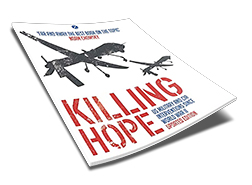
Killing Hope
Author: William Blum | Pages: 472 | Size: 3.5 MB In Killing Hope, William Blum, author of the bestselling Rogue State: A Guide to the World's Only Superpower, provides a devastating and comprehensive account of America's covert and overt military actions in the world, all the way from China in the 1940s to the invasion of Iraq in 2003. Is the United States, as it likes to claim, a global force for democracy? Killing Hope - now in an updated edition - shows the answer to this question to be a resounding 'no'. |
The Israel Lobby & US Foreign Policy
Author: John J. Mearsheimer | Pages: 83 | Size: 1 MB Mearsheimer and Walt, political scientists at the University of Chicago and Harvard, respectively, survey a wide coalition of pro-Israel groups and individuals, including American Jewish organizations and political donors, Christian fundamentalists, neo-con officials in the executive branch, media pundits who smear critics of Israel as anti-Semites and the American-Israel Public Affairs Committee, which they characterize as having an almost unchallenged hold on Congress. This lobby, they contend, has pressured the U.S. government into Middle East policies that are strategically and morally unjustifiable: lavish financial subsidies for Israel despite its occupation of Palestinian territories; needless American confrontations with Israel's foes Syria and Iran; uncritical support of Israel's 2006 bombing of Lebanon, which violated the laws of war; and the Iraq war, which almost certainly would not have occurred had [the Israel lobby] been absent. |
The Autobiography of Malcolm X
Author: Alex Haley | Pages: 278 | Size: 1 MB The Autobiography of Malcolm X (ISBN 0-345-35068-5) was written by Alex Haley between 1964 and 1965, as told to him through conversations with Malcolm conducted shortly before Malcolm X's death (and with an epilogue after it), and published in 1965. The book was named by Time magazine as one of the ten most important nonfiction books of the 20th century. |
Gujarat Files - Anatomy Of A Cover Up
Author: William Blum | Pages: 125 | Size: 1 MB Gujarat Files is the account of an eight-month long undercover investigation by journalist Rana Ayyub into the Gujarat riots, fake encounters and the murder of state Home Minister Haren Pandya that brings to the fore startling revelations. Posing as Maithili Tyagi, a filmmaker from the American Film Institute Conservatory, Rana met bureaucrats and top cops in Gujarat who held pivotal positions in the state between 2001 and 2010. The transcripts of the sting operation reveal the complicity of the state and its officials in crimes against humanity. |
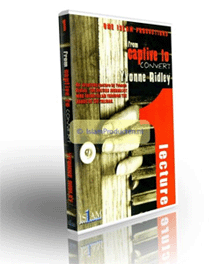
America's War on Terror | Yvonne Ridley
"... They were bombing and decimating the population for reasons only known to the USA and its Allies. The poor Taliban had no idea why America wished to invade Afghanistan. They had heard of this as a 'mishap' but had no idea of the enormity of the tragedy. They did not know of the complexity of the buildings and people jumping out of towers 100 stories high, as they did not have tv’s nor did they know a tower when they were told about it..."
|
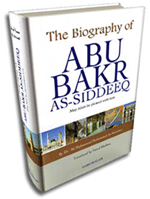
Abu Bakr al Siddiq : His Life and Times
This series of lectures covers the different aspects of the life of Abu Bakr (R.A.), including his life before Islam, during the life of the Prophet Muhammad (P.B.U.H.), and finally during his Khalifah. CD 1 | CD 2 | CD 3 | CD 4 | CD 5 | CD 6 | CD 7 | CD 8 | CD 9 | CD 10 | CD 11 | CD 12 | CD 13 | CD 14 | CD 15 | Download E-Book |
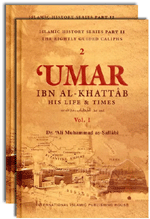
Ummar Ibn Alkhataab - His Life and Times
Ummar Ibn Alkhataab (R.A.), His Life and Times by Imam Anwar Al-Awlaki. This series of lectures covers the different aspects of the life of Ummer Ibn Alkhataab(R.A.) CD 1 | CD 2 | CD 3 | CD 4 | CD 5 | CD 6 | CD 7 | CD 8 | CD 9 | CD 10 | CD 11 | CD 12 | CD 13 | CD 14 | CD 15 | CD 16 | CD 17 | CD 18 | Download E-Book |
The Fitnah
A look at the early history of Islam from the time of Uthman Ibn Affan..until Abdullah Ibn Azzubair. CD-1: The life of Uthman Ibn Affan: His Khilafa and the begining of the Fitnah. CD-2: The beginings of the Fitnah(cont). The assassination of Uthman and the pledge to Ali. CD-3: Ali regains the provinces and the Army of Aisha, Talha, and Azzubair. CD-4: The Battle of Al-Jamal and the Battle of Siffin. CD-5: The Battle of Siffin (cont). The emergence of the Khawaarij. The assassination of Ali. The Khilafa of Al-Hassan Ibn Ali and Muawiah. CD-6: Muawiah (cont). Yazeed Ibn Muawiah. The martyrdom of Al Hussein Ibn Ali and Abdullah Ibn Azzubair. |

The Tragedy of KarbalaOn the 10th of Muharram Al-Haram, 61 A.H., a most abominable and tragic event occurred in the desert of Karbala that resulted in the martyrdom (shahadah) of Hussain Ibn Ali (RAA), the grandson of our Prophet (SAW) and the son of his daughter, along with most of the members of his family and their supporters. It should be borne in mind that this tragedy did not take place all of a sudden like a bolt from the blue. It was in fact the manifestation of the plot of Sabayees which had claimed the life of Uthman (RAA), the third Caliph and the son-in-law of the Prophet (SAW) twenty-five years earlier. Caliph Uthman´s (RAA) martyrdom took place on 18th of Dhu Al-Hajj, 36 A.H. |
Biographies of the Rightly-Guided CaliphsAuthor: Ibn Kathir | Pages: 416 | Size: 22 MB Ibn Katheer, At-Tabari, As-Syooti and Other Historians. The four Rightly guided Caliphs (Khaliph's) Abu Bakr As-Sideeq, Umar ibn Al-Khattaab, Uthmaan Ibn 'Affaan and Ali Ibn Abi Taalib. The Biography of Umar Ibn Abdel-Azeez who is regarded as one of the Rightly Guided Khaliphs is also included in this book |
Featured Article
|
"And such are the days..." In light of current events, and the apparent ease with which the Children of Israel - the killers of the Prophets and the breakers of covenants - kill and maim even the infants sitting in their strollers, I invite you to ponder over the following incidences: 'Uthman bin Shaybah - of the tribe of Bani 'Abd ad-Dar - was the custodian of the Ka'bah, and was the carrier of its keys. One day, he opened up the Ka'bah for the leaders and heads of Quraysh, to find the Messenger of Allah amongst those waiting to enter it. 'Uthman (then a mushrik) pushed the Prophet in the chest, saying to him: "You are not worthy of entering!" So, the Prophet said to him: "O 'Uthman, what would you think if, one day, you were to see these keys in my hands, with me doing with them as I please?" 'Uthman responded: "That would be the day that Quraysh will be destroyed and humiliated." Not even ten years passed until the Messenger of Allah was holding onto the covering of the Ka'bah, looking at the massive number of people who had surrendered and submitted themselves to him and his army, saying to them: "O Quraysh! What do you think I should do with you?" He was saying this with the flashbacks and memories of thirteen years of pain and torture that he had suffered at the hands of those whose lives were now in his hands; memories that he could not bear to relive: of thorns being thrown in his path, of intestines being placed on his back while prostrating in that very location only years before, of the starvation, of the humiliation in front of his family and Companions - and now, he is asking them: "What do you think I should do with you?" He then walked over to 'Uthman bin Shaybah, and took the keys to the Ka'bah from his hand. Also, ponder over these more recent examples from the history of the Islamic movement in Egypt, in particular: Hamzah Basyuni was the warden of the Egyptian military prison in which Sayyid Qutb, Zaynab al-Ghazali, etc. were being held. When he would torture his prisoners, they would plead with him, saying "For the Sake of Allah, stop!" And what was his response? What was this filthy waste of a nutfah's response to these Muslims? He would say to them: "If Allah Himself were to come here, I would throw Him into a prison cell!" - Glorified is He. In Zaynab al-Ghazali's memoirs, 'The Return of the Pharoah,' she mentioned how Hamzah Basyuni would say to her: "Which Hell is hotter: the Hell of your Lord, or the hell of 'Abd an-Nasir? You will remain in the hell of 'Abd an-Nasir until you approve of his rule!" Not even eight months passed after Hamzah Basyuni supervised the execution of Sayyid Qutb, except that he and his assistants all found themselves thrown into the depths of prison. Sha'rawi Jumu'ah - the Interior Minister, whose name would cause Egypt itself to shake in terror and fear - one day received a request from Muhammad Qutb to visit his sister, Hamidah, after not having seen her for seven years (they were in the same prison together). The request went through the prison guard first, and he was refused out of fear of Jumu'ah, saying that he was unable to help at all. The request was then passed on to the general supervisor of the prison, and he also refused to help, out of fear of the Interior Minister. Finally, the request reached Jumu'ah himself, to which he replied: "Tell Muhammad Qutb that he will not see his sister, either dead or alive." Not much time passed since this incident, except that Sha'rawi Jumu'ah - the feared Interior Minister - found himself thrown into the depths of prison, with Muhammad and Hamidah Qutb at home, safe and sound. Finally, take the case of Anwar Sadat: he had thrown scholar after scholar into his jails, saying about the last one of them: "He is like a dog, rotting in prison!" Not even a month passed after this statement of his that he made in public, except that - while sitting in the midst of his bodyguards and secretaries - officers of his own army aimed their sniper rifles and shotguns at him, pointblank. Nobody lifted a finger to defend him or fend off the attack, save the bodyguard of the American ambassador who happened to be present. Those who came to kill Sadat - may Allah have Mercy upon them - no attempt to stop or repel their attack was made, except from a single person sitting and guarding an American diplomat. And where is Sadat now...{"And neither the Heavens nor the Earth wept for them, nor were they given respite."} [ad-Dukhan; 29] So, these are a few examples in which the tables were turned before either side knew it, and it was made clear that the fate of all oppressors and wrongdoers is the same, sooner or later. So, remember: {"And such are the days: We rotate them between the people..."} [Al 'Imran; 140] Allah Knows best. Translated by Abu Sabaayaa |







