Worship

In the Name of Allâh, the Most Beneficent, the Most Merciful
|
Shaikhul-Islaam Ibn Taymiyyah (rahimahullaah) said: "Ibaadah is obedience to Allaah by carrying out what He has commanded on the tongues of His messengers."
|
|
Fortress of the Muslim (Hisnul-Muslim)
Invocations from the Qur'an & Sunnah. Translation of Hisnul-Muslim. (aka 'Citadel of the Believer') This is a very beautiful booklet consisting of many authentic Dua's (supplications) for a Muslim to supplicate on a daily basis and on special occasions. Author's Note... This book is an abridgment of my earlier work entitled, Adh-Dhikr wad-Du'a wal-'llaj bir-Ruqyah mina'-Kitab was-Sunnah. In order to make it small and easily portable, I have chosen only the section on words of remembrance for this abridgment. To achieve this, I only mentioned the text of the words of remembrance instead of the entire Hadith. I also limited myself to mentioning only one or two references from the original book for each Hadith. Whoever would like to know about the Companion who related a particular Hadith, or more information about where it is recorded, should refer to the original work (mentioned above). I ask Allah the Glorious, the Mighty, by His beautiful Names and by His sublime Attributes to accept this as having been done sincerely for His sake alone. I ask Him to bring me its benefits during my lifetime and after my death. May those who read it, those who print it, or have had any role in distributing it, benefit from it also. Surely He, glory be unto Him, is Capable of all things. May the peace and blessings of Allah be upon our Prophet, Muhammad, and upon his family and Companions and whoever follows them in piety until the Day of Judgment. Said bin Ali bin Wahaf Al-Qahtani, Safar,1409 CD 1 | CD 2 | E-Book |
The Humility in Prayer
Author: Ibn Rajab al-Hanbali | Pages: 80 | Size: 6 MB This is a treatise we have written concerning humility (Khushu') and the hearts meekness and breaking (inkisar) before the Lord. The basic meaning of Khushu', is the softness of the heart, its being gentle, still, submissive, broken, and yearning. When the heart is humble, so too is the hearing, seeing, heard, and face; indeed all the limbs and their actions are humbled, even speech. This is why the Prophet (saw) would say in his bowing (ruku), "My hearing, sight, bones, and marrow are humbled to You," another narration has, "and whatever my foot carries." One of the Salaf saw a man fidgeting in his prayer and remarked, 'If the heart of this person was humble, so too would his limbs be.' The source of the Khushu, that takes place in the heart is the gnosis of Allah's greatness, magnificence, and perfection. Teh more gnosis a person has of Allah, the more Khushu' he has. The greatest action of worship which manifests the Khushu, of the body to Allah is the prayer (Salaah). Allah has praised those who have Khushu' in the prayer. |
Dua: The Weapon of The Believer
Author: Abu Ammar | Pages: 237 | Size: 12 MB In this work, the author elaborates on the status, importance and etiquette of dua' in Islam. In the most comprehensive work yet to be written in English on the topic, the author discusses, amongst other matters: the excellence and benefits of du'a; the types of du'a; the pre-conditions that are needed in order for a du'a to be accepted; the recommended etiquette of performing du'a; the timings and situations in which a du'a is more likely to be answered; the various factors that aid or prevent a du'a from being accepted; the relationship of du'a with the Divine Decree (qadr); the wisdom behind a delayed response, and many other relevant topics. |

Golden Stories of Accepted Prayers
In a real sense these are requests which come from the bottom of our hearts to ALLAH Almighty. Allah is always ready and happy to receive prayers from anyone at any time. If you're facing any difficulties or trouble you should immediately turn to ALLAH for help. The best invocations are those narrated by the Prophet. If you don't speak Arabic, you can pray in your mother tongue. When we pray we should feel assured that ALLAH will accept our requests. We should do so with complete sincerity and devotion. Prayers can be made at any time, but there is a greater possibility our prayers will be accepted if we do so at specific times... |

30 Lessons For Those Who Fast
Author: Aa'id Abdullah al Qarni | Pages: 142 | Size: 4 MB In relation to fasting, this book contains the most pertinent Qur'anic verses, authentic ahadeeth, delightful poetry and touching advice. It is therefore, a book for the righteous when they meet for pleasant conversations. It is also a gift for wayfarers when they break their journeys for rest, a treasure for those who share mutual love and respect - For Ramadhan is indeed the noblest month and its days are the sweetest days... |

Ahmad ibn Hanbal's Treatise on Prayer (Salah)
Author: Imam ibn Hanbal | Pages: 27 | Size: 1 MB The treatise by Imam ibn Hanbal, the Imam of the Hanbali school of juristic reasoning, renowned for his steep knowledge, was written several hundred years ago to the inhabitants of a town where the Imam stayed for a period of time. It contains a full and clear description of the prayer and includes detailed observations of the mistakes, which Imam Ahmad observed during his time in that town. It was and remains an invaluable work for all Muslims. Detailing as it does many common errors made during prayers, some of which are serious enough to invalidate the act of worship. The book includes several explanatory notes by the translator, Sameh Strauch, a convert to Islam from England |

Congregational Prayer
Author: Dr Saalih ibn Ghaanim al-Sadlaan | Pages: 287 | Size: 14 MB The Congregational Prayer is one of the most important outward manifestations of Islam. Prayer is of extreme importance to the well-being of a persons religion. But prayer in Islam is more than just an individual spiritual experience. It is mean to be performed in a congregation - the foundation of a Muslim society as a whole. In this work, Dr al-Sadlaan has done an excellent job of discussing the most important fiqh topics related to the Congregational Prayer. The following topics are covered in this work, the wisdom behind Congregational Prayer, the place for performing Congregational Prayer and the virtues of attending the mosque, the legal status of the Congregational Prayer, repeating a paryer in congregation, performing sallat al-taraweeh of Ramadhaan in congregation, women performing Congregational Prayer and many other topics. This book is essential reading for all Muslim leaders and Imaams. |

Fiqh Made Easy
Author: Dr Saalih ibn Ghaanim al-Sadlaan | Pages: 186 | Size: 9 MB In this work, the world- renowned scholar of comparative fiqh, Dr. Saalih al-Sadlaan of Muhammad ibn Saud Islamic University discusses the most important issues of fiqh. In this work, the author has done an excellent job of concisely mentioning the most important aspects of the different fiqh topics he discussed. Furthermore, he has discussed many issues that are not greatly discussed in the English literature, such as the rules concerning bequests and endowments. Hence, this work was chosen to be translated as a welcomed addition to the available English literature. |

The Concise Presentation of Fiqh
Author: Dr. ‘Abdul-Azeem Badawi | Pages: 704 | Size: 50 MB This valuable introductory compilation of fiqh (Islamic jurisprudence) issues takes the reader by the hand and shows him/her clearly what to do. As the author restricts the discussion to what is most directly derived from the Qur’an and the Sunnah and, therefore, above dispute, this book is valuable both as a work of fiqh and as a collection of sound hadiths. |
Fiqh us-Sunnah
Author: As-Sayyid Saabiq | Volumes: 4 | Size: 25 MB
He wrote the book in Arabic at the request of Imam Hassan al-Banna, the founder of the Muslim Brotherhood (Ikhwan). Every Fiqh ruling in the book goes back to the Qur'an and Sunnah and Sabiq dealt with all four madhahib objectively, with no preferential treatment to any.
|
Sharh 'Umdah al Fiqh
Author: Ibn Qudamah Al-Maqdisi | Pages: 308 | Size: 1 MB The Fiqh of Worship. The book of al-‘Umdah is an abbreviated book of Fiqh according to the hanbali school of Fiqh (madhhab). Fiqh is a subject that to some extent is being neglected these days with more concerted efforts taking place in the realm of aqidah (creed), and although it is undoubtedly pertinent that one learn what is permissible and not in relation to their beliefs, it is similarly important that the Muslims know what is permissible or otherwise in terms of their actions. |

ar-Risala fi Usul al-Fiqh
Author: al-Imam al-Shafi’i | Pages: 387 | Size: 62 MB Written in the second Islamic century by al-Imam al-Shafi’i (d. 204AH/820AD), the founder of one of the four Sunni schools of law. This important work gives the fundamental principles of Islamic jurisprudence and its influence continues to the present day. During the early years of the spread of Islam, the exponents of Islamic legal doctrine were faced with the problems raised by ruling and administering a diverse and rapidly growing empire. In Medina and Kufa, as well as other cities of early Muslim rule, schools of law had to be developed, but it took the genius of Muhammad b. Idris al-Shafi’i, born in the year 150AH/767AD, to establish the principles by which the various legal doctrines could be synthesised into a coherent system. In the Risala, which laid down the basis for such a synthesis, al-Shafi’i established the overriding authority, next only to the Qur’an, of the Sunna or example of the Prophet Muhammad as transmitted in the traditions. |
A Summary of Islamic Jurisprudence
Author: Saalih Al Fawzaan | Volumes: 2 | Size: 58 MB This book is an introduction to Islamic Jurisprudence for readers without substantial background in this field. In two volumes, Shaykh Saalih Al Fawzaan has projected light on jurisprudential issues of utmost importance in a genuine and reader-friendly style, free from any jargon or sophisticated expressions. |
Mukhtasar Minhaj Al-Qasidin | Towards The Hereafter
Author: Ibn Qudamah Al-Maqdisi | Pages: 464 | Size: 23 MB This work has taken Important Points and Objectives from The Minhaj Al-Qasidin of Ibn Al-Jawziyy which in tern is a Summary of that Magnus Opus of Imam al-Ghazali The 'Ihya Ulum Ad-Din', however Ibn Al-Jawziyy Compiled the book free from weak or fabricated Hadith.
Ibn Jawzi Says
" I Have relied only on Authentic an famous narrations, and I deleted from or added to the original book what seems necessary"
The Four Chapters of this Book are: |
Salvation Through Repentance
Author: Bilal Philips | Pages: 91 | Size: 8 MB This book clearly and concisely presents the Islamic concept of Tawbah (repentance) and its viewpoint wherein salvation by faith and salvation by deeds are combined in a truly unique manner. A book that is relevant to every Muslim. |
Ways Of Gaining Provision From Allah
Author: Daar al-Watan | Pages: 15 | Size: 1 MB This brief treatise outlines ways of increasing ones provision from Allah (swt) according to Quran and Sunnah. |

The Goodly Word - Al Kalim al Tayyib
Author: Ibn Taymiyyah | Pages: 371 | Size: 6 MB Written by the renowned jurists of the fourteenth century, Taqi al-Din Ahmad Ibn Taymiyyah, The Goodly Word is one of the most referred to works on prayer and the merits of prayer. Exclusively based on what the Prophet Muhammad himself said and did, this work includes prayers for every moment of the Muslims life. The Goodly Word is here presented in a bi-lingual edition so that the exact prayers of the Prophet can be read in the original Arabic. The translation is by two distinguished scholars who have also translated An-Nawawi's Forty Hadith and Forty Hadith Qudsi both published by the Islamic Texts Society. |
More than 1000 Sunan for Every Day & Night
Author: Shaykh Khaalid Al-Husaynaan | Pages: 176 | Size: 13 MB 'More than 1000 Sunan for Every Day & Night.' Based on the Arabic Book 'Akthar min alf Sunnah fee-al-yawm wa al-laylah'. Is it not amazing that in the course of a normal day, many of us are capable of practicing more than 1,000 Sunan? Surely, in clinging to the Sunnah is safety and security, as Imaam Maalik said: "The Sunnah is like the Ark of Noah-whoever embarks on it reaches salvation and whoever refuses is drowned." This short booklet contains statements and actions of the Prophet Muhammad (S) that are performed in a typical day - how many of these are part of our daily lives? This work is the English-language translation of the Arabic booklet, More Than 1,000 Sunan Every Day & Night, complied by Shaykh Khaalid Husaynaan. He is a contemporary student of knowledge of our time who is preoccupied with reviving and following the Sunnah of Prophet Muhammad (S). |
Mashari Rashid Dua Qunoot Text
|
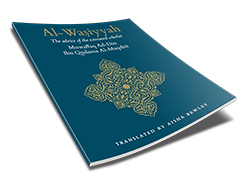
Al-Wasiyyah - The Advice Of The Esteemed Scholar Ibn Qudamah
Author: Ibn Qudama al-Maqdisi | Pages: 41 | Size: 1 MB This book is a distillation of the wisdom gained after years of study of sacred texts from the Islamic tradition. The author, Muwaffaq ad-Din al-Maqdisi, is one of the foremost scholars in the Hanbali school, and this concise and inspiring work sums up the realities of this world and the next, gathered in kernels of advice to his fellow believers. |
Path of the Wayfarer - Minhaj al-Salikin (Hanbali Fiqh)
Author: Shaykh as-Sadi | Pages: 224 | Size: 15 MB Path of the Wayfarer, an English translation of the Arabic book, Minhaj al-Salikin, a book on Hanbali jurisprudence. The book is famous among the circles of Islamic studies in jurisprudence in the Middle East. The book was written by the author for the purpose of acquainting the reader with the jurisprudence rulings on matters that pertain to his religion. Although, the book is largely based on the Hanbali School, the author did not strictly adhere to all its rulings. If he found a stronger opinion with another School, he would adopt it and place that within his work. The book was written in a simplified manner, choosing only the opinions that he deemed to be the strongest along with their evidences, irrespective of the School of Thought it belonged to. It is an excellent book for a beginner as well as those who are more advanced in the subject. The books works as a guide for those who wish to study the subject matter. |

An Epitmoe of Hanbali Substantive Law (Hanbali Fiqh)
Author: Yusuf b. 'Abd al-Hadi al-Hanbali | Pages: 183 | Size: 6 MB This book is a translation of Yusuf b. 'Abd al-Hadi's (d. 909/1503) Hanbali law manual, Kitab furu al-fiqh. The purpose of this rendition is to present the main aspects of Islamic law in a simple and modern manner. The manual at hand is considered to be the shortest law manual in the Hanbali school. The translation covers the articles of law pertaining to the aspects of worship ('ibadat) and social dealings (mu'amalat). |

The Mukhtasar Al-Quduri (Hanafi Fiqh)
Author: Imam al-Quduri | Pages: 923 | Size: 30 MB The Mukhtasar al-Quduri is one of the most celebrated and influential treatises in any Muslim school of Methodology and thought and is the foundation for the Hanafi school.it is both the first source for scholars and a manual for the general reader.This is its first ever complete translation in English. Translated from the Arabic with Introduction and Notes by Tahir Mahmood Kiani. |

Nur al-Idah: The Light of Clarification (Hanafi Fiqh)
Author: Hasan ibn Ammar Abu al Ikhlas al-Misry Shurunbulali | Pages: 437 | Size: 20 MB Nur al-Idah is a Hanafi text which includes vast areas of jurisprudence, namely, the rulings pertaining to worship. It leaves the student or general reader well prepared to deal with the majority of matters ranging from purification, prayer, funerals, zakah to hajj. It reveals in a small way as to why the Hanafi Madhhab is held in such high esteem from scholars all over the world. It is practical, sensible and can be used as a reference book. This book is based on the teachings of Abu Hanifa and his students, namely Imam Muhammad, Abu Yusuf and Zufar; and will provide the reader with a brief look as to why the Hanafi Madhhab is the most widely embraced in the world today. |

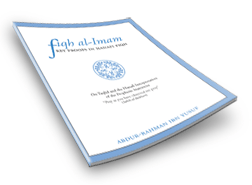
Fiqh al-Imam (Key Proofs in Hanafi Fiqh)
Author: Abdur-Rahman ibn Yusuf | Pages: 130 | Size: 23 MB The first part of this book seeks to clarify certain aspects of taqlid that have been misunderstood and gravely distorted. It sheds light on the necessity of taqlid, its history, and its role in today’s world. The second part includes several chapters devoted to issues regarding salat [ritual prayer] according to the Hanafi school of law. Through illustrative examples and detailed discussions, the chapters on prayer sufficiently demonstrate the sophisticated legal philosophy employed by the Hanafi school (indeed all the madhhabs) in their derivation of legal rulings from the source texts of Islam. |
The Salah of a Believer (Hanafi Fiqh)
Author: Abu Yusuf Riyadh ul Haq | Pages: 113 | Size: 16 MB This book describes the procedure of salâh from the beginning to the end according to the fiqh of Imam Abu Hanifah, his mujtahid companions and their countless followers. Rather than simply list the juristic pronouncements of the Imams, it details every movement and posture of salâh and substantiates them from the ahadeeth of the Prophet , the narrations of the Sahâbah and Tabi’un and, where relevant, from the verses of the Qur’ân. It thus demonstrates that the method of salâh in the Hanafi fiqh is not only in total agreement with the Qur’ân and Sunnah but is, in fact, derived exclusively from them as understood, practiced and taught by the Sahâbah and the learned Muslims of the early generations. |

Selected Friday Sermons
Author: Ifta Office Washington | Pages: 388 | Size: 16 MB This book is a must for every Imam and anyone who expects to give Friday sermons in the English speaking world. The sermons contained in this book are collected from the sermons of Prophet Muhammad (S) himself, his companions and various prominent scholars. The sermons are both educational and heart moving, therefore fulfilling the goal of the Friday sermon. Every Muslim who attends the Friday congregational prayer wants to have his faith increased with inspirational and encouraging exhortations, and at the same time be sure that the information that he is receiving is Islamically correct. Thus, we present this collection of sermons in hopes that it will assist the reader in delivering quality religious speeches, thereby fulfilling the obligation of the Friday sermon in the best manner. May Allah grant us success. |

Glorious Sermons from The Haram
Author: Sheikh As-Sudais | Pages: 358 | Size: 30 MB Glorious Sermons from The Haram Sheikh As-Sudais Glorious Sermons from The Haram Sheikh As-Sudais His Eminence Dr. Abdur Rahman bin Abdul Aziz As-Sudais is one of those fortunate and renowned personalities who holds a high and outstanding position in the Muslim world. This book is the first collection of his Jumu'ah sermons which he delivered in Haram Makkah after doing intensive preparation for each Khutba, thus making each Khutba unique and outstanding. It is produced in a beautiful and meaningful format for readers who are keen to study it. This collection contains sermons spanning a quarter of a century. These sermons were delivered mainly from the pulpit of the Holy Mosque of Makkah. |

Etiquettes of a Muslim on Friday
Author: Abu Ibrahim Abdul Majid | Pages: 76 | Size: 3 MB Many people are unaware of what the etiquette of a Muslim on Friday should be and most are unaware of its significance. Most do not consider the Friday Prayer as obligatory, hence they miss it intentionally. Many people in Islamic countries are on holiday on this day, so then spend their time sleeping, or in other activities that cause them to neglect the Friday prayer altogether. They do not realise the significance of the Friday Prayer and its sermon, and they come to the mosque according to their own wishes and desire. Most of them are unaware of what is required from a Muslim before or after the Friday Prayer. It is with these concerns in mind that this book has been written. |

The Religious And Moral Doctrine Of Jihad
Author: Ibn Taymiyyah | Pages: 36 | Size: 1 MB Ibn Taymiyyah verdicts in regards to Jihad are often not available especially on whom Jihaad is to be carried out. The shaykhs verdicts are filled with a sea of knowledge that oulines fighting not only the enemy aggressor, but also apostates and even those who oppose clear cut rulings of Islam, despite their claims to be Muslims Ibn Taymiyyah was given the title Shaykh ul-Islam and his numerous Fataawa are a vast source of inspiration and Islamic legal opinion. Ibn Taymiyyah died in Prison in Damascus on the night of Sunday/Monday 20th Dhu-I-Qadda |

Jihad in the Qur'an and the Sunnah
Author: Abdullah Humaid | Pages: 21 | Size: 1 MB 'After the testimony of Oneness of Allaah swt and the Messengership of Muhammad , with firm belief and True Faith, one has to perform the acts of worship as ordained by Islaam. Among the obligatory acts of worship are offering the Salat (prayers), observing the Saum (fasts), paying the Zakat and performing the Hajj (pilgrimage to Makka). Besides these acts of worship, a Muslim is directed to abstain from evil deeds and to perform good deeds, so that he may achieve success in the Hereafter, as well as, in the life of this world. But, as regards the reward and blessing, there is one deed which is very great in comparison to all the acts of worship and all the good deeds-and that is Jihad ! |