Knowledge

In the Name of Allâh, the Most Beneficent, the Most Merciful
|
Sufyaan Ath-Thawree, raHimahullaah, said: "The excellence of knowledge is due only to the fact that it causes a person to fear and obey Allaah, otherwise it is just like anything else." [Related by ibn Rajab]
|
Minhaj Al-Muslim (2 Vol. Set)
Author: Abu Bakr Jabir Al-Jaza'iry | Volumes: 2 | Pages: 1062 A comprehensive work by the great scholar Abu Bakr Jabir Al-Jaza'ri comprising all that concerns a Muslim regarding creed, manners, providing direction for righteous character, acts of worship, and dealings with his colleagues. |

The Excellence of Knowledge
Author: Ibn Rajab al-Hanbali | Pages: 90 | Size: 4 MB The Virtue of the Salaf Over the Khalaf (Ibn Rajab al-Hanbali). These are some brief words about the meaning of knowledge and its classification into that which is beneficial and that which is not; as well as a note regarding the excellence of the knowledge of the Salaf over that of the Khalaf. The way and wisdom of the Salaf, all goodness lies in traversing the way of the Salaf, beneficial Knowledge with regards the ‘Inner Sciences’, the foundation of knowledge and many other branches of the beneficial knowledge. |
Inheritors of the Prophets
Author: Ibn Rajab al-Hanbali | Pages: 145 | Size: 8 MB Possessing scholarly knowledge of Islam brings you closer to your lord, Most Exalted. He is the Possessor of all knowledge and out of His Mercy, has granted some knowledge to His Creation so that they can learn about Him and love Him and Worship Him alone. Such sacred knowledge provides a direct route to whomever toils for it, to the Messenger of Allah (peace and blessing be upon him); and what an excellent inheritance it is. no honour could be greater and sublime than taking from the fountains of Prophets and Messengers. |
The Seekers of Sacred Knowledge
Author: Ibn Jawzi | Pages: 102 | Size: 2 MB This letter by one of the great scholars from Salaf is addressed to his son Abu'l-Qasim Badr al-Din 'Ali who began to spend his days in idle play and wasting his time doing some impermissible things. |

Provisions for the Hereafter (Zaad Al-Ma'ad)
Author: Ibn Al-Qayyim Al-Jawziyyah | Pages: 494 | Size: 15 MB Allah has sent the Messenger (S) with guidance and the Religion of Truth. Strict adherence to the guidance of His Prophet (S) is required from the followers of Islam. The scholars of the Islamic community have attached great importance to it and produced texts regarding the Acts of Worship, Dealings and Habits in the light of the Divine guidance. This book is one of the most famous works written on this subject. This book is one of the important resources of knowledge for those who seek to know the Seerah of their Prophet (PBUH) as well as, the Fiqh learned from it. This is a book that is unique in that it explains the Sunnah through the Seerah and the Seerah through the Sunnah. |

Zad-Ul-Ma'ad (4 Volumes)
Author: Ibn Al-Qayyim Al-Jawziyyah | Volumes: 4 This book is one of the important resources of knowledge for those who seek to know the Seerah of their Prophet sallallaahu alayhi -wa-sallcun) as well as, the Fiqh learned from it, this is a book that is unique in that it explains the Sunnah through the Seerah and the seerah through the sunnah. It is profound classic work _containing thousands of pages written by Imam Ibn Al Qayyum while on the Hajj journey (Pilgrimage), from Damascus to Makkah. Despite its being written from memory, the several thousand incidents, Hadiths, Ayat (verses of the Quran), Fiqh benefits, as well as, names of the companions associated with them, were remarkably close to the truth with marginal errors. |
Ranks of the Divine Seekers (Madarij al-Salikin)
This is an unabridged, annotated, translation of the great Damascene savant and saint Ibn Qayyim al-Jawziyya's (d. 751/1350) Madarij al-Salikin. |
Travelling In The Pursuit Of Knowledge
Before you is the English translation of the classical treatise al-Rihla fi Talab al-Hadith by the great scholar of the Shafi’i school of jurisprudence and the imam of his time, Khatib al-Baghdadi. His complete biography from Imam al-Dhahabi’s voluminous workSiyaar A’laam al-Nubala has also been translated and added herein. This treatise is essentially a gathering of powerful and insightful narrations (of the Companions, pious predecessors, and the Prophet Musa) that emphasise the importance of travelling and exerting efforts towards seeking knowledge. |
A Collection of Knowledge and Wisdom
Author: Ibn Rajab al Hanbali | Pages: 642 | Size: 28 MB This is an English translation of Ibn Rajab al Hanbali's classic work Jami'al Ulum Wal Hikam. It is basically a listing of 50 ahadith (sayings of the Prophet), and along with them are comments, lessons to be learned from them, and sayings of the Sahaba regarding them. |
Ibn Qayyim al-Jawziyyah On Knowledge
Author: Ibn Qayyim al-Jawziyyah | Pages: 335 | Size: 32 MB The renowned theologian and jurist Ibn Qayyim al-Jawziyya wrote numerous titles, many of which are still popular today. Amongst these is Key to the Blissful Abode (Miftah Dar al-Sa'ada). The present work is an abridgement of the first volume of Key to the Blissful Abode. In it, Ibn Qayyim focuses on the importance of knowledge and willpower, as means through which a person may attain Paradise. Willpower is the door and knowledge - in particular knowledge which pertains to God and His Attributes, the Qur'an and the example of the Prophet - is the key. Ibn Qayyim discusses the virtues and benefits of knowledge over wealth and worldly matters; the path to knowledge; the importance of pursuing knowledge and applying it in order to achieve guidance from God and protect oneself from doubts; the superiority of the scholar over the worshipper; the necessity of using knowledge and willpower as the bases for all actions if one is to achieve spiritual bliss. |
Knowledge Mandates Action
Author: Al-Khateeb Al-Baghdaadee | Pages: 64 | Size: 1 MB
Iqtidaa-ul-‘Ilm al-‘Amal By Al-Khateeb Al-Baghdaadee. This is the second book in the "Classical Knowledge Series", which is a collection of selected scholarly works from the past that deal with the subject of religious knowledge. The first book in this blessed series was “The Book of Knowledge” written by Imaam Abu Khaithamah Zuhayr bin Harb An-Nasaa’ee (Died 234H), may Allaah have mercy on him.
|

The Book of Knowledge
Author: Imaam An-Nasaa'ee | Pages: 36 | Size: 1 MB This is the first book in the 'Classical Knowledge Series' - a collection of selected scholarly works from the past that deal with the subject of religious knowledge. This particular book is a translation of the famous classical work "Kitaab-ul-'Ilm", a collection of narrations about the virtues, merits, manners, and etiquettes of knowledge, written by Imaam Abu Khaithama An-Nasaa'ee (Died 234H). In this initial instalment, the reader will have a glimpse into the statements and actions of our pious predecessors with regard to seeking, spreading and implementing knowledge. There are over 160 narrations in total, including statements of the Prophet, his Companions, the Taabi'een and the suceeding early generations. In addition to this, the scholar of Hadeeth of recent times, Muhammad Naasir-ud-Deen Al-Albaanee, has reviewed the treatise and verified the narrations contained within it, distinguishing the authentic from the weak. So this treatise is of great benefit and deserving of being read and studied by every Muslim, whether in gatherings or individually. |

The Etiquette of Seeking Knowledge
Author: Bakr Aboo Zayd | Pages: 99 | Size: 6 MB The Etiquette of Seeking Knowledge ... to adorn oneself with beautiful etiquette, noble manners, good behaviour, and pious conduct are distinguishing characteristics of the people of Islaam, and knowledge - the most precious pearl in the crown of the purified Shareeah - cannot be attained except by those who adorn themselves with its etiquette and those who leave evil qualities associated to it. For this reason the scholars devoted their attention to this etiquette, outlined its importance and wrote books solely on this topic; either pertaining to (general conduct] with all types of knowledge or to specific types of knowledge such as the etiquette of the carriers of the Noble Quireaan, the etiquette of the muhaddith, the etiquette of the muftee, the etiquette of the qaadee (judge), the etiquette of the muhtasib (the one who enjoins good and forbids evil for the sake of Allaah) and so on. The issue of this book is the general conduct of those who take the path of seeking the knowledge of the Sharee'ah. |

The Manners of the Knowledge Seeker
Author: Abu 'Abdillah Muhammad Sa'id Raslan | Pages: 71 | Size: 1 MB
Translated By Abu Sabaayaa.
|

The Distinguished Jurist's Primer
Author: Ibn Rushd | Pages: 1136 | Volumes: 2 Ibn Rushd was a Maliki Jurist (Qadi) but presents the views of other schools ( Hanifi, Shaf'ee, hanbali & Zahiri) with the usual Respect and objectivity. This book is among the best known example of the Shari'a science of Ilm al Khilaf (the knowledge of variant ruling) It is one of the most well known works of ilm-ul- Khilaf, a discipline that records and analyses the differences among Muslim Jurists. |

The Foundations of Usul
Author: Ibn Uthaymin | Pages: 142 | Size: 20MB The Prophet (PBUH) said: “If Allah intends good for anybody then he gives him understanding (fiqh) in deen”. It is not possible for the one with understanding (fiqh) to be without usul al-fiqh or for the usuli (the one who knows usul al-fiqh) to do without fiqh if he wants to have understanding (of the deen). - Shaykh Al-Uthaymin, Kitab Al-Ilm |

Man-Made Laws vs. Shari'ah
Author: ibn Salih al-Mahmood | Pages: 382 | Size: 8 MB This book appears at a time when many other books and ideas are being propogated to justify the status quo of the ummah, and the position of those who are not ruling by what Allah has revealed and to detract from the seriousness of the situation. |

Al-Ahkam as-Sultaniyyah | The Laws of Islamic Governance
Author: Abu'l Hasan al-Mawardi | Pages: 382 | Size: 6 MB Al-Ahkam as-Sultaniyyah written in the fith Century Hijri is perhaps the single most comprehensive account of the workings of Islamic governance and equally a highly influential theoretical outline of the nature of that governance. Woven throughout it are accounts of the first community of Islam and the judgements of the early scholars of the salaf which are the book's lifeblood and its light. Covering all the various aspects of the deen of Islam which are the concern and responsibility of the Khalifah, his amirs, his wazirs (ministers) and deputies. The rights and duties of these persons are expounded in detail. |

Criminal Justice In Islam
Justice is a central theme in the Quran, dictating the traditions of Islamic law and how this should be put into practice. The Quran states what the various punishments for certain crimes should be along with the justification behind this reasoning. 'Criminal Justice in Islam' contains information about Islamic rulings concerning crimes committed against people, Hadud (Prescribed Punishments) for consuming alcohol, adultery, theft, robbery, apostasy and sorcery. It is part of the "Encyclopedia of Islamic Jurisprudence Concerning Muslim Women" series written by Yusuf Al-Hajj Ahmad. |
Muslim International Law (Kitab al-Siyar al-Saghir)
Author: ibn al-Hasan Ash-Shaybani | Pages: 64 | Size: 12 MB Muslim International Law may be defined as: That part of the law and custom of the land and treaty obligations which a Muslim state observes in its dealings. Imam Muhammad ibn al-Hasan Ash-Shabani- was a pupil of Abu Hanifah and heard hadith from Mis'ar ibn Kidam, Sufyan ath-Thawri, 'Amr ibn Dinar, Malik ibn Maghul, Imam Malik ibn Anas (, al-Awza'i, Rabi'ah ibn Salih, Bakir and Qadi Abu Yusuf. He resided in Baghdad and narrated hadith there. He was Muhammad ibn al-Hasan ash-Shaybani His kunya was Abu 'Abdullah. He was born in 132 and died in 189 AH. He was only about eighteen years old when Abu Hanifa died and had not been with him for a long time, but nonetheless he compiled a more complete study of the fiqh of Iraq than Abu Yusuf. He took from ath-Thawri and al-Awza'i, and travelled to Malik and learned the fiqh of hadith, transmissions and the opinions of Malik, after having learned fiqh of opinion from the Iraqis. He stayed with Malik for three years. He was appointed a qadi under ar-Rashid but was never Chief Qadi. He had great skill in letters and so he had both linguistic training and analytic perception. He was concerned with his appearance so that ash-Shafi'i said about him, "Muhammad ibn al-Hasan fills both the eye and the heart." He also mentioned his great eloquence. |

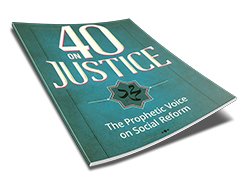
40 on Justice: The Prophetic Voice on Social Reform
Author: Omar Suleiman | Pages: 352 | Size: 9 MB Justice is essential to the survival and flourishing of any civilization. The words of God and His Messenger remind us of the centrality of justice in our lives and our societies. Injustice (zulm) is condemned repeatedly in the Qu'ran and the teachings of the Prophet ï·º. How are we to confront injustices in our personal lives, our communities and our societies? In an age of widespread injustices against the weak, the vulnerable and the dispossessed, how does Islam teach us to respond? |
The Evolution of Fiqh (Islamic Law & The madh-abs)
Author: Bilal Philips | Pages: 149 | Size: 1 MB The origin of Islamic law and its evolution and the four schools of law (math-habs) are discussed in this work along with the reasons for differences among them. This is probably Bilal Philips best-selling work on the various schools of thought in Islam, including detailed facts, insight, and commentary on the four major madhabs as well as other, less-known madhabs in Islam. Includes mini-biographies on various eminent Islamic scholars the Evolution of Fiqh (Islamic Law & the Madh-habs), the author very clearly presents a brief overview of the historical development of Islamic law and its schools (the Madh-Nabs). The book identifies the main reason for the appearance of the Madh-habs and the factors leading to differences among them. For those to whom the Madh-habs have been a mystery, this aspect of the book will he extremely enlightening. Although the author sheds light on both the positive and negative roles of the Madh-habs in the past, the main message of the book is call to the understanding the differences (with an aim to remove them where possible) |

The Legal Status of Following a Madhab
Author: Muhammed Taqi Usmani | Pages: 79 | Size: 1 MB The Nature of Taqleed, The Concept of Taqleed in the Qur'an Taqleed in the Sunnah, The Era of the Companions and Absolute Taqleed Taqleed of an Individual during the Time of the Companions and their Followers, The Need for Following a Particular Imam Taqleed of an Individual Why the Four Schools of Thought, The Different Levels of Taqleed, The Taqleed of the Lay Person, The Taqleed of an Expert Scholar, The Taqleed of a Scholar who is a Mujtahid in his School, The Taqleed of an Absolute Mujtahid, Responses to Doubts Raised Against Taqleed, The Following of Forefathers is Condemned in the Qur'an, The Condemnation of Taqleed of Savants and Sages, The Hadith of Adi ibn Hatim, Radi-Allahu anhu, The Statement of Abdullah ibn Mas'ood, Radi-Allahu anhu, The Statements of Mujtahid Imams Themselves, How Does a Lay Person Recognize a Mujtahid Is Taqleed a Defect?, The Taqleed of an Individual and Following one's Whims and Fancies, The Taqleed of an Individual and New Issues The Hanafi School of Thought and Ahadith Imam Abu Hanifa and his Knowledge of Hadith, Inertia in Taqleed |

Path of the Wayfarer - Minhaj al-Salikin (Hanbali Fiqh)
Author: Shaykh as-Sadi | Pages: 224 | Size: 15 MB Path of the Wayfarer, an English translation of the Arabic book, Minhaj al-Salikin, a book on Hanbali jurisprudence. The book is famous among the circles of Islamic studies in jurisprudence in the Middle East. The book was written by the author for the purpose of acquainting the reader with the jurisprudence rulings on matters that pertain to his religion. Although, the book is largely based on the Hanbali School, the author did not strictly adhere to all its rulings. If he found a stronger opinion with another School, he would adopt it and place that within his work. The book was written in a simplified manner, choosing only the opinions that he deemed to be the strongest along with their evidences, irrespective of the School of Thought it belonged to. It is an excellent book for a beginner as well as those who are more advanced in the subject. The books works as a guide for those who wish to study the subject matter. |

An Epitmoe of Hanbali Substantive Law (Hanbali Fiqh)
Author: Yusuf b. 'Abd al-Hadi al-Hanbali | Pages: 183 | Size: 6 MB This book is a translation of Yusuf b. 'Abd al-Hadi's (d. 909/1503) Hanbali law manual, Kitab furu al-fiqh. The purpose of this rendition is to present the main aspects of Islamic law in a simple and modern manner. The manual at hand is considered to be the shortest law manual in the Hanbali school. The translation covers the articles of law pertaining to the aspects of worship ('ibadat) and social dealings (mu'amalat). |

The Mukhtasar Al-Quduri (Hanafi Fiqh)
Author: Imam al-Quduri | Pages: 923 | Size: 30 MB The Mukhtasar al-Quduri is one of the most celebrated and influential treatises in any Muslim school of Methodology and thought and is the foundation for the Hanafi school.it is both the first source for scholars and a manual for the general reader.This is its first ever complete translation in English. Translated from the Arabic with Introduction and Notes by Tahir Mahmood Kiani. |

Nur al-Idah: The Light of Clarification (Hanafi Fiqh)
Author: Hasan ibn Ammar Abu al Ikhlas al-Misry Shurunbulali | Pages: 437 | Size: 20 MB Nur al-Idah is a Hanafi text which includes vast areas of jurisprudence, namely, the rulings pertaining to worship. It leaves the student or general reader well prepared to deal with the majority of matters ranging from purification, prayer, funerals, zakah to hajj. It reveals in a small way as to why the Hanafi Madhhab is held in such high esteem from scholars all over the world. It is practical, sensible and can be used as a reference book. This book is based on the teachings of Abu Hanifa and his students, namely Imam Muhammad, Abu Yusuf and Zufar; and will provide the reader with a brief look as to why the Hanafi Madhhab is the most widely embraced in the world today. |

Elements Of Shafiee Fiqh
Author: Umar Abdul Jabbar | Pages: 34 | Size: 1 MB A breif summary of Shafiee Fiqh, the contents page reads as follows: Elements Of Islam, Islamic Laws, Taharah, Najasat, Istinja, Wudhoo, Ghusl, Tayammum, Naidh and Nifaas, Salaah, Arkaan-us-Salaah, Pre-Sunan of Salah... |

Code of Scholars : Usul al Fiqh Notes
Taught by Sheikh Yaser Birjas |
Forbidden
The Forbidden, Issues Of Great Importance That We Underestimate. Al-Muharramat (the forbidden) are the limits of Allaah (the Mighty and Magnificent). "These are the limits of Allaah, so do not approach them". . Allaah has threatened whoever transgresses His limits and violates His sacraments stating (Glorified be He): "And whoever disobeys Allaah and His messenger and transgresses His limits - He will put him into the fire to abide eternally therein, and he will have a humilating punishment." It is obligatory to avoid al-muharramaat in view of the saying of the prophet: "And whatever I forbade you, then avoid it and whatever I enjoined upon you, then fulfill as much of it as you able." I ask Allaah guidance, success, and observance of His limits for myself and for my Muslim brothers. I ak Him (Glorified be He) to help us avoid al-muharramaat and protect us from sins and evil deeds, Allaah is the best protector and He is the Most Merciful (Author) |
Advice To The Seekers of Knowledge
Author: Sultan Al Utaybi | Pages: 12 | Size: 1 MB By Shaykh Sultan Al Utaybi. Part of a series of writings advising the Talib ul Ilm (student of knowledge). |
Adorning Knowledge with Actions
Shaykh Husayn al-Awaayishah. I felt that I should hurry in bringing forward the hadeeth: "The two feet of the son of Aadam will not move from near his Lord on the Day of Judgement until he is asked about five (matters): about his life - how he spent it; about his youth - how he took care of it; about his wealth - how he earned it; and where he spent it; and about that which he acted upon from the knowledge that he acquired," as an aid towards purification of the souls and preparation for death. The advice being firstly to myself, secondly to the du'aat (callers to Allah's path) and thirdly to all my Muslim brothers in every part of the world - hoping that Allah, the Most High, will cause benefit through that which I have written and that the fruits of that may be reaped, now and in the future. In this treatise I restricted myself to one part of the hadeeth and that is "…and about that which he acted upon from the knowledge that he gained." From the Author's Introduction |

The Fitnah Of The Dajjal And Gog And Magog
Imam as-Sa'di said: The fact that the time in which he will come is unknown indicates that no believer can guarantee safety for himsel from encountering that time. This is an affair which is possible, and its evil and fitnah are to be feared. The need of the slave for having protection from his fitnah by all means is something known. And from the greatest means is seeking refuge with Allah from him. Also, this is through supplication and fearing his fitnah. Thus, it is inevitable that one does so in all levels of his ummah. This is a firmly placed 'aqidah, to the point that if it occured and its occurrence is actualized, then this ummah-specifically those who have a connection to the correct and sound belief system-will be able to defend itself from this evil and be protected from his fitnah. In contrast, if the fear of him were to be removed from the hearts, then the fitnah would be increased when that time comes. And the believers would have no tangible iman to eradicate his fitnah and evil. |

Fleeing From The Fire
Hell is the final abode prepared by Allah; the Most High for those do not believe in Him; those who transgress against His Laws and deny His Messengers. It epitomises the scourge of punishment; filled with indescribable torment; pain and grief that has been detailed by Allah and His Messenger (peace and blessings be upon him). It is often observed from our righteous predecessors that they regularly took account of themselves lest they become negligent of the Hereafter and fall under divine retribution that'll be weighed against mankind on the Day of Judgement. When a fire torch was once lit for Umar ibn Al-Khattab; he felt angst at it's burning heat; so he reprimanded himself; "How will you be patient if you encounter this O son of Al-Khattab!" He was of course; making a worldly parallel with the unparalleled Fire of Hell. |
Heavenly Dispute
This is another classical work of Imam Al-Hafidh Ibn Rajab in the English language. It is an important commentary on the noble hadith of the Prophet (peace and blessings be upon him) that was recorded in the collection of Sunan Tirmidhi relating the dispute among the chief Angels of the Highest Heaven. The dispute arose about deeds that expiate sin and raise a person's rank in the Hereafter. The Prophet (peace and blessings be upon him) said of this hadith, "Indeed, it is the truth, so study and learn it." Therefore it is necessary for every Muslim to take extra keen interest in learning its lessons, understanding its values and applying its highly prized recommendations. |

Lessons Learnt From The Story Of Yusuf
Shaikh Abdur-Rahman ibn Nasir As-Sa'di. These are some insights gained from the story of Yusuf, may Allah raise his repute and the refute of all the Prophets and Messengers. Indeed Allah related the story unto us in detail, and singled this story out with His words: "Truly there are signs and lessons in [the story] of Yusuf and his brothers for those asking [about the story of Yusuf or for signs of the Prophethood of Muhammad]." [Surah Yusuf: 7] |
Oppression and the Oppressors
This is book is by Sheikh Ul Islam Ibn Taymiyyah, Imam Ibn Rajab Al Hanbal, Imam Ibnul Qayyim Al Jawziyyah & Imam Mohammed Mutwali Al-Sharawi. when such names are mentioned on a cover of a book. A muslim should buy the book with his or her eyes closed. These are some of the greatest scholars of all times. some of the topics in the content pages are |
Waswasah
Author: Ibn Qayyim al-Jawziyyah | Pages: 93 | Size: 4 MB The Interpretation of the book: 'Dham Al-Muwaswiseen wat-Tahdheer Minal Waswasah'. By Imam and Scholar Muwafaq Deen bin Qudaam al-Hanbali (ibn Qudamah al-Maqdisi al-Hanbali). Written by Imam Ibn Qayyim al-Juziyyah. Discussion of many related topics, such as: Niyyyah in taharah and salaah, Excessive use of water in wudu and bathing, Disregarding any waswasah about breaking wudu, Things that people are harsh in implementing, Carrying children during salah, Use of water left in open containers. |
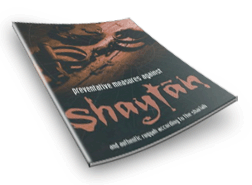
Preventative Measures Against Shaytan
Author: Mustafa Ibn Al-Adawi | Pages: 93 | Size: 3 MB Indeed It is only Shaytan that suggests to you the fear of his helpers, so fear them not, but fear Me, if you are (true) believers. Surah Al-'Imran 3:175} When Shaytan inflicts a person with his touch it is blinding, and it obstructs the vision, but fear of Allah along with contemplation and submission to Him enables the heart to become connected with Allah. This state arouses the heart from neglecting His guidance so that those with taqwa remember, and when they make remembrance of Allah their vision is opened and covering is removed so that they become clear sighted. |
Exposing Shaytan
Author: Shawana A. Aziz | Pages: 81 | Size: 6 MB It is due to the seriousness of Shaytan’s fitnah (temptation, tribulation, trial) that Allah has distinctly exposed his goals and plots in the Qur’aan. The Prophet (sallallahu alaihe wasallam) repeatedly warned against Shaytan’s power to tempt mankind into disobeying Allah. He (sallallahu alaihe wasallam) would relentlessly reveal Shaytan’s trickery and deceit and inform about ways of defense against the accursed. |

Cupping The Great Missing Therapy
Author: Dr. Sahbaa M. Bondok | Pages: 240 | Size: 10 MB Dr. Sahbaa M. BondokCupping (Hijama Therapy) is a marvelous procedure for eliminating stagnation and improving blood flow, especially in the back. The practitioner creates suction in a cup; the skin gets sucked up and rises under the cup as blood rushes up. Cupping is an ancient practice that has become increasingly available to the public. Although, it recently gained publicity in the western world and the United States, cupping is one of the most famous medical recommendations of Prophet Muhammad (Sallallaahu Alayhi Wasallam). |








