Aqeedah

In the Name of Allâh, the Most Beneficent, the Most Merciful
|
Aqidah linguistically is derived from the term aqada. In Arabic, one states, "Aqada the rope" when the rope is tied firmly. And, "Aqada the sale" or "He settled the sale" when the person ratifies and contracts a sale or agreement. And Allah says in the Quran, "And as for those whom your right hands have made a covenant (Ar., aqadat)" [Al-Nisa 33]. And Allah also says, "But He will take you to task for the oaths which you swear in earnest (Ar., aqadtum) [Al-Maida, 89] which means asserted and adhered to, as proven in the verse, "And break not oaths after the assertion of them" [An-Nahl, 91]. If one says, "Aqadtu such and such," it means his heart is firm upon such and such.
|
|
Islamic Creed Series
Author: Dr Umar S al-Ashqar | Volumes: 8 | Size: 14 MB Nothing is more important to the believer than attaining admittance to Paradise and avoiding Hell. This will be the fruit of his/her deeds in this life. These issues, which are matters of the unseen, are major issues of faith. In this book, Dr Ashqar has covered all the facts pertaining to these issues. The descriptions of Paradise and Hell and their inhabitants will make every reader more concious of his/her ultimate goal in life and keep him/her mindful of these realities. |

|
Kitab At-Tauhid
Author: ibn Abd Al-Wahhab | Pages: 193 | Size: 20 MB Kitab At-Tauhid is one of the best books on the subject of Tauhid (Monotheism) and ranks high in authenticity. In this book all the relevant verses of the Qur'an have been discussed reasonably, rationally, and sincerely. The essence of the Qur'an and Sunnah is placed in a very simple manner in this book. |
|
Concise Commentary on the Book of Tawhid
Author: Saleh Al-Fawzan | Pages: 516 | Size: 21 MB This book gives a clear explanation of the Muslim sound Creed which is the core of the religion of Islam, as the belief in Tawheed (monotheism) is the purpose for which Allah created both mankind and jinn, and thus, those whoes belief in Tawhid is corrupt, are not considered Muslims. It is a commentary on the Book of Tawhid written by Shaykh Muhammad Ibn Abdul Wahhab. |
|
Kitaab At-Tawheed Explained
Author: Ibn Abdul Wahhab | Pages: 352 | Size: 16 MB The most important subject for a Muslim to comprehend is Allah’s monotheism and the full implications of that belief, as without that, no act of worship or good deed is accepted by Allah, nor rewarded in the hereafter. Sameh Strauch has rendered one of the finest books on this subject into English, and he provides explanations of every major point. |
|
Sharh Aqeedah al-Tahawiyyah
Author: Ibn 'Izz Al-Hanafi | Pages: 150 Each | Size: 14 MB Each Commentary by Allamah Ibn 'Izz Al-Hanafi on Imam Tahawi's Al-Aqeedah At-Tahawiyah. About the Author: A Hanafi Jurist, born in Taha (that's where Tahawi came from), a town in Upper Egypt. Both of his parents were learned and attended Imam Ash-Shafai's lectures. Became a Hadith scholar, but also developed an interest in Hanafi Fiqh. Thus, he was both-- a Muhaddith and a Faqih. He wrote many books, mostly on Fiqh. Compiled a brief list of Core Beliefs of Ahl-al-Sunnah wa al-Jama'ah, now known as Sharh al-'Aqidah at-Tahawiyyah. Imam At-tahawi said about this compilation: "This is a presentation of the beliefs of ahl-al-Sunnah wa al-Jama'ah..." |
|
Explanation of al-‘Aqeedatul-Hamawiyyah
Author: Saaleh al-'Uthaymeen | Pages: 139 | Size: 1 MB By Imaam Muhammad Ibn Saaleh al-'Uthaymeen. Allah upholds His religion with His close helpers upon whom He bestows Eemaan, knowledge, and wisdom by which they prevent these enemies. They repel their plot back against their own throats. So no one ever comes out with his innovation except that Allaah – and for this deserves praise and thanks – destines to send someone from Ahlus-Sunnah who refutes and disproves his innovation and extinguishes it. He has many works on the clarification and explanation of the Sunnah, the reinforcement of its pillars, and the destruction of innovations. One of the works on this subject is his “al-Fatwaa al-Hamawiyyah” which he wrote as an answer to a question presented to him in the Hijrah year of 698 from Hamaah, a place in ash-Shaam. In it, he was asked what the scholars and Imaams of the religion say concerning the Aayaat and the Ahaadeeth of the Sifaat, or the attributes and characteristics of Allaah. So he answered in about 83 pages and due to which, he suffered trials and afflictions. May Allaah reward him on behalf of Islaam and the Muslims with the best of rewards. Due to the difficulty in understanding and comprehending this answer from many readers, I wanted to summarize the most important points from it along with some other needed additions. I have named it “Fathu Rabb-il-Bariyyah bi-Talkhees al-Hamawiyyah.” |

|
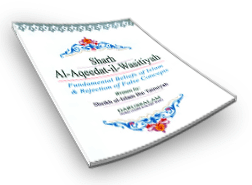
Sharh Al-Aqeedat-il-Wasitiyah
Author: Ibn Taymiyyah | Pages: 223 | Size: 22 MB The eminent scholar of Islam, Sheikh-ul-Islam Imam Ibn Taymiyyah, discusses the real & original faith of Islam according to the Qur'an & Sunnah. It deals with the perfect and undefiled Islamic Faith and Creed of the As-Salaf-As-Salih (Pious Predecessors) particularly in regards to Allah's names and attributes, with solid arguments in brief words and terminologies. The book is highly appreciated by the scholars for its brevity as well as comprehensiveness; and for its contents produced in line with the Qur'an and Sunnah in an appealing and manifest manner. |
|
Al-'Aqidah Al-Wasitiyyah (2 Vol. Set)
Author: Muhammad Ibn Saalih al-'Uthaymeen | Volumes: 2 A detailed commentary/explanation of the famous writing of Shaikh Al-Islam Ibn Taymiyyah, al-Aqeedatul-Wasitiyah, done by the noble Shaykh, Muhammad Ibn Saalih al-'Uthaymeen (Rahimahumullaah). Two large deluxe volumes contain a detailed study/explanation on the topic of creed/aqeedah (belief in oneness of Allah). |

|
Kitab Al-Iman
Author: Ibn Taymiyyah | Pages: 483 | Size: 14 MB Book of Faith represents the first complete English translation of the important and well-known work Kitab Al-Iman, written by the renowned scholar Ibn Taymiyyah. The concept of Iman, faith, is fundamental to Islam. Iman has served to define the nature of Muslim life and the essence of the religion as a whole. |

|
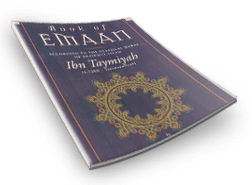
Book of Emaan
Author: Ibn Taymiyyah | Pages: 269 | Size: 15 MB The source of all evil is the deviation from the truth and its straight path. The goodness of all matters is the following of truth and adherence to its right way. Truth is the fixed state in which Allah has created every creature in a particular way and managed its affair in a certain manner. Allah is Perfect and exempt from any deficiency or error. This book aims to elucidate the pillars of Emaan (basis of belief, faith) and the characteristics of Kufr (disbelief) and its causes. |
|
Explanation to the Beautiful and Perfect Names of Allah
Author: Abdu-r-Rahman Nasir As-Sa'di | Pages: 109 | Size: 2 MB To Allah belong the most beautiful and perfect Names, so invoke Him by them. Abandon those who desecrate His Names, they will be recompensed for what they did.? From the most noble and lofty stations of cognisance is to know the Lord, the Glorious, through His beauty. This is the knowledge possessed by the elite of this creation. All of them know Him through an Attribute from amongst His Attributes but those amongst them who have the most complete cognisance are those who have most complete cognisance are those who know Him through His perfection, magnificence and beauty. |

|
Allah's Most Beautiful Names and Lofty Attributes
Author: Muhammad Ibn Khalifah al-Tamimi | Pages: 153 | Size: 5 MB Among the subjects that have not been adequately covered in the English language, perhaps the most important of them is the one covered in the pages of this book. The author presents the belief of Ahl al-Sunnah wal-Jama'ah, which is the creed of the first few generations of Muslims and those who followed in their footsteps. Besides outlining the principles and foundations of this creed he also highlights some of the foreign ideas and deviant concepts that have crept into the hearts and minds. The style in which this book has been written relates more to a textbook than to a book for casual reading. The author has carefully structured the book, divided it into clearly headed sections and provided all the necessary definitions and explanations that will facilitate a clear understanding of this immensely important branch of knowledge. |

|
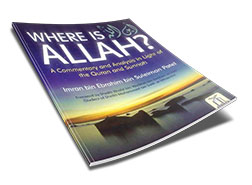
Where Is ALLAH
Author: Imran Bin Ibrahim bin Suliman Patel | Pages: 148 | Size: 35 MB The issue regarding the highness of ALLAH has been argued by many people even though it is one of the most clearest and important matters of belief. However, this brief explanation will clarify how a person's Islam cannot be complete unless he believes in this matter. The evidence for the Highness of ALLAH has reached the level of absolute acceptance in number of narrations. Imam Ibn Qayyim al-Jawziyyah said that the evidences for affirming the highness of ALLAH have over 2000 proofs. He mentioned in his work al-Nuniyyah. Oh People! We swear by ALLAH the majestic that our statement has not 1000 proofs to affirm it rather 2000! In addition some contemporary scholars mentioned that the evidences reach well over 3000 proofs, all of them explicitly proving that Allah is above the heavens, above his throne, that He rose over His throne and that He is separate and distinct from His creation |
|
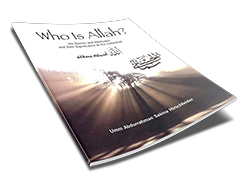
Who Is Allah?
Author: Umm Abdurrahman Sakina Hirschfelder | Pages: 276 | Size: 1.3 MB "Who Is Allah?" is more than just a book about Allah's names and attributes. It aims to build a bridge between knowledge of Allah and practical application of this knowledge in a person' daily life. By delving into why knowledge of Allah is important and how to apply this knowledge, the reader is given a means upon which to act in his or her quest for a close and rewarding relationship with Allah. |
|
Guide to Sound Creed
Author: Dr. Salih Al-Fawzan | Pages: 359 | Size: 19 MB Clarifying the sound Muslim Creed and calling people to believe in it, is the most crucial issue because it is the foundation on which one's deeds are judged whether denied or accepted. This book gives clear explanation of the Muslim sound creed as pointed out in the Quran and Sunnah. |

|
The Creed of Ibn Abi Zayd Al-Qayrawani
Author: Abdullah Ibn Abi Zayd al-Qayrawani | Pages: 208 | Size: 6 MB Translation of Muqaddimah Al-Risalah ibn Abi Zayd al-Qayrawani by Imam Abu Muhammad Abdullah Ibn Abi Zayd al-Qayrawani (310-389 AH). With commentary of Shaikh Ahmad ibn Yahya Al-Najmi (d. 1429 AH) and the accompanying Arabic text. The author was asked to write a short treatise on the fundamentals of belief and creed of Ahlus Sunnah Wal Jamaah. This work was written in response to that request, wherein the author explains the obligatory aspects of Islam, those that should be pronounced by the tongue, believed in the heart, acted upon the limbs and acts of Sunnah related to the foundations of faith. |
|
The Grave - Punishments and Blessings
Author: Husayn al-Awayishah | Pages: 96 | Size: 6 MB Question abound about what happens after death. In western societies, in particular, there is a great deal of speculation on these matters. Mulsims, however, have answers to these quetions. Islam tells us what we can expect when we have finally made our exit from this world; we are also given ample guidance as to how we may best prepare ourselves and earn the rewards of Paradise in the Hereafter. In this book the author outlines the Islamic teaching on death and the grave. It is an essential reading for any Muslim who wants to know more about the topic from the authentic sources of Islam. |
|
Book of the End - Great Trials & Tribulations
Author: Ibn Kathir | Pages: 749 | Size: 38 MB Like everything, the present universe will also come to an end, and it is a part of our faith to believe in the Last Day. The signs of the Day of Judgment have been foretold by our Prophet (S). Ibn Kathir has collected all the prophesies of the Prophet (S) in his book Al-Bidaayah wan-Nihaayah. In this volume, we have presented from them the signs of the Hour and the events that are yet to take place, although mentioning very few examples of those prophesies that have already been realized. |

|
Allah (swt) Governance on Earth
Author: Abu Hamza | Pages: 342 | Size: 1 MB Taken from author's introduction, ' I hope that you on reading these words are found to be in sound health and strong imaan. Due to the absence of books in English regarding Tawhid-ul-Haakimiyyah it was deemed necessary to put together this large research work on the subject. We were also grieved to find that this subject was not being given the attention that it deserves by shaikhs, maulana’s, mosque committees and the average Muslim. Along with this, and the negligence of the scholars and their adherents in presenting the ails of the Ummah and giving the workable solutions, we saw the impending reality of putting together a research covering the most common controversy today, the Shari`ah and it’s implementation.' |

The Friends of Allah & The Friends of Shaytan
Author: Ibn Taymiyyah | Pages: 415 | Size: 22 MB The Decisive Criterion between the Awliyaa of The Most Merciful and the Awliyaa of Shaytaan Indeed the enmity between man and Shaytaan is old, commencing from the time that Adam (alayhi as-salaam) was created, from the time he was ordered to prostrate to him. Shaytaan refused, become arrogant and hence disobeyed his Lord. His arrogance and pride let him to commit a whole host of sins, it made him expend every effort in misleading the children of Adam and made him beautify and embellish sins such that they accepted them and eagerly committed them Due to this Allah the exalted revealed the Books sent the Messenger and enjoined His servants to various injunctions and admonitions in order to secure them from the evil of Shaytaan. In the light of His advice, profound injunctions and admonitions in order to secure them from the evil of Shaytaan. In the light of His advice, profound injunctions and sever warnings, mankind becomes separated into two groups: a group who were guided and a group who deserved to be misguided. The groups who were guided are the inhabitants of Paradise and the groups who were misguided are the denizens of the Fire. The inhabitants of Paradise are the Awliyaa of the Most Merciful and the denizens of the Fire are the Awliyaa of Shaytaan. |
Pillars Of Islam And Iman
Author: Muhammad bin Jamil Zino | Pages: 264 | Size: 60 MB In this Book, the learned writer discussed the fundamental constituents of Islam: Salat (prayer), Saum (fasting), Hajj and Zakat etc., in a lucid and impressive manner. The discussion regarding Faith and Belief in the first part is and added value to the book. The distinctive feature of this book is its simplicity. Anyone can learn & practice Islam easily through the guidance of this book. |
Taqwiyat-ul-Iman (Strengthening of The Faith)
Author: Shah Isma'il Shaheed | Pages: 79 | Size: 1 MB The author refers to the Quranic verses and Ahadith by interpreting them in a very simple and comprehensible style, and also brings to light the true status of all the unlawful customs and rituals which are commonly practiced in the society and are detrimental to the faith of Tauhid. Tauhid (Oneness of Allah) is the basis of the Islamic religion. |
The Fundamentals of Tawheed (Islamic Monotheism)
Author: Dr. Abu Ameenah Bilal Phillips | Pages: 250 | Size: 7 MB This book presents a detailed explanation of the classical Islamic concept of God's unity as it relates to faith and acts of religious devotion. It also discusses the major areas within which the Islamic unitarian belief (Tawheed) is either nullified or compromised by idolatrous concepts and practises, collectively called Shirk |

At-Tadhkirah (The Reminder)
Author: Imam Al-Qurtubi | Pages: 400 | Size: 32 MB An Authentic Selection from Imam Al-Qurtubi's At-Tadhkirah Fiahwalil-Mawta Wal-Akhirah
|
Three Fundamental Principles of Islaam
Author: ibn Saalih Al-Uthaymeen | Pages: 133 | Size: 1 MB This book is a clear explanation of that which we should all know about our religion. In fact it is a detailed answer to the three questions that we will all be asked in our graves, as such this book will prove to be beneficial for everyone. The author has firmly based his book upon the Qur'an and Sunnah. |

|
The Tawhid Of Action
Author: Abdullah Yusuf Azzam | Pages: 13 | Size: 1 MB While living in Afghanistan, I have realized that Tawhid can not pernetrate into the soul of the human being, nor will it intensify and strengthen - the way it does in the fields of Jihad. This is the Tawhid, regarding which the Messenger of Allah (PBUH) said 'I was sent before the hour with the sword...' Why? 'So that Allah is worshipped Alone with no partners with Him.' |
|
Islamic Creed Based on Quran and Sunnah
Author: Muhammad bin Jamil Zino | Pages: 63 | Size: 5 MB In this book, all important and fundamental aspects of Islam are described in an easy form of question/answer, so that the basic concepts may be inscribed in the minds of the readers. Shaikh Muhammad bin Jamil Zeno is originally from Syria, but for a long time he has been a teacher in Dar-ul-Hadith AlKhairiyah, Makkah AlMukarramah. Besides being a great scholar, he is also the author and compiler of many books. He holds the honor to have a place in the rank of those authors of present time whose work has been widely accepted. |

The Signs Before the Day of Judgement
Ibn Kathir This book is an extract from Ibn Kathir's book called "Al Bidayah Wa Al Nihayah" (The beginning and the ending). This book is an authoritative source on a matter of central importance to everyone: the events of the here-after. The work is by Ibn Kathir, an eminent Islamic scholar and is based entirely upon authentic Islamic texts and sources. According to many of prophet's sayings, he described the condition in which people would live in those times. Some of the developments foretold by the Prophet (S) have already come to pass. This book summarizes those and others in more detail. |

Faith in Predestination (Qada Wa Qadar)
Dr. Suhaib Hasan Belief in predestination (Qada wa Qadar) is an undisputed article of faith in Islam. For some people, this belief leads to contentment and satisfaction, even in the face of hardship and adversity. But for others, it provides justification for their wrongdoing: how often do we hear people arguing that they should not be blamed for their disobedience since it has already be decreed by Allah that they will sin? |

The World of the Angels
Author: Sheikh Abdul-Hamid Kishk | Pages: 98 | Size: 6 MB The World of the Angels is an example of traditional learning and its translation fills a much needed gap in aqida (beliefs) literature in the English speaking world Basing himself exclusively on the Quran and Hadith, Sheikh Kishk deals with every aspect of the angelic world. He goes from discussing the creation. tbnm and nature of the angels to enumerating their many different types and also explains their role in existence and the character of their interaction with the human race. An in depth understanding of the nature and activity of the angels is essential for the people of today. Particularly in the face of the onslaught of scientific materialism which has done so much to weaken the bases of belief in this time. This book should help a great deal towards this end. |
Rays of Faith: Fundamentals of Faith Notes
Rays of Faith. A seminar to enlighten the minds and hearts, as we continue on our journey towards Allah SWT and explore the deeper meanings of the last five of the six articles of Islamic faith: Angels, Divine Books, Messengers, the Day of Judgment and Al-Qadar. |
|
The Purification of Tawhid from the Filth of Deviation
Author: al-Imam al-Amir Muhammad ibn Isma il al-Sana'ani | Pages: 81 In recent times, a deviation has appeared amongst some Muslim communities wherby they show veneration, to an extreme, of Muslims saints and rigghteous personages: they erect mausoleums on their graves, they go to them in times of need and adversity, they supplicate to them and they hold beliefs concerning them that border on the superstitious. Distressed at theis gross deviation, al-Sana ani penned this treatise expounding on the belief of Ahlu'l Sunnah in its pristine purity. The issues he tackled wher th concept of worship and grave-worship , supplcation to Allah, relying on Allah, relyoing on Allah and resorting to Him at times of need. |
|
The Foundations of Islam
Author: Imam Muhammad Ibn Abdul-Wahhab | Pages: 158 Classical and concise treatise of Muhammad bin Abdil-Wahhaab known as Masaa-il-ul-Jaahiliyyah or "Aspects of the Days of Ignorance." The source treatise consists of 128 aspects that the disbelievers adhered to at the time of the advent of Prophet Muhammad (SAWS) which he came to oppose them in. The author extracted these aspects from the Qur'aan and Sunnah and summarized them in a short treatise as individual points. |

An Explanation of Kitab At-Tawhid
The series of ten lectures covers the following topics: CD 1: Etiquettes of the student & teacher of knowledge. CD 2: Shirk- Its definition & its types (major & minor). CD 3: Kufr- Its definition & its types; Nifaq (hypocrisy). CD 4: Study of al-Jahiliyah, al-Fisq & ad-Dalaal; Apostasy. CD 5: Knowledge of the unseen; Magic & fortune-telling; Sacrifices; Rulings of statues & symbols of remembrance CD 6: Ruling on nationalism and 'isms'; Use of ruqyah & amulets. CD 7: Loving the Prophet;Importance of sending salah & salam upon him. CD 8: Virtues of the household and the companions of the Prophet. CD 9: Bid'ah (innovation) - Its meaning, types and ruling. CD 10: Stance of Ahlus-Sunnah towards innovators; Current innovations. |

|
AudiosAqeedah Al-Hamawiyah | Ali At-Tamimi Part 1 | Part 2 | Part 3 | Part 4Sharh of al-Aqîdah al-Wâsitiyyah | Ali At-Tamimi Part 1 | Part 2 | Part 3 | Part 4 | Part 4 Cont | Part 5 | Part 6The Reality of Iman | Ammar Amonette Part 1 | Part 2 | Part 3 | Part 4 | Part 5 | Part 6 | Part 7 | Part 8 | Part 9 | Part 10The Need To Rule By Allah's Laws | Ammar Amonette Part 1 | Part 2 | Part 3 | Part 4 |






